Check out this new article written by GTI’s president Thomas Hoenig on M2M strategies: http://reliabilityweb.com/articles/entry/m2m-strategies-for-machine-tool-maintenance
Check out this new article written by GTI’s president Thomas Hoenig on M2M strategies: http://reliabilityweb.com/articles/entry/m2m-strategies-for-machine-tool-maintenance
04 March 2016: GTI Predictive Technology, Inc., creators of the iPad Data Collector, unveiled VibePro 7.3 – a major new update to GTI’s groundbreaking vibration analysis application for iPad. Developed specifically for the iPad, VibePro provides a simple and easy solution to performing vibration analysis on the iPad. New in version 7.3 are features many of our customers have been asking for.
Time wave form support is now available. Users can record anywhere from 1 to 6 seconds of TWF data. Measurements taken in this format are included in the main VibePro route and sent up to VibePro Online for full analysis and reporting. VibePro Online provides analysis of the TWF as an acceleration FFT, velocity FFT, or displacement FFT, as well as, the original TWF.
Rearranging the machines in the route has also been added. This greatly requested feature required a great deal of engineering time to rewrite both the iPad and web app to recognize this kind of major database change. When in edit mode a simple tap and drag allows the user to easily reorganize the order of the machines.
Another tentpole feature in this release is one specifically for our oldest customers. As some databases grow now over 4 years old; some customers were looking for an easy way to clean out the old data. New in version 7.3 is the ability to mass archive measurement data. The user selects how many measurements per point that is desired to keep and the old data is removed from the database. Several backup options are available in VibePro for customers wishing to retain the historical data for their records.
Other new features include:
VibePro 7.3 is a free upgrade to owners of VibePro. Pricing for new customers and information about VibePro can be obtained by contacting GTI Predictive Technology at info@gtipredictive.com or calling us at (888) 473-9675.
About GTI Predictive Technology
Founded in 1997, GTI Predictive Technology, developers of the Predictive Maintenance Platform for iPad, brings their experience in asset monitoring and repair to the predictive maintenance industry. Our passion for helping others through predictive maintenance allows us to continue to improve our products based on real customer demand.


GTI Predictive Technology on a recent service call investigated a problem with a dual disc centerless grinder. This one year old grinder had been performing poorly, causing downtime and poor parts quality. Using GTI’s VibePro iPad vibration tools, our service technician discovered that both spindles in the machine were running much faster than rated for the machine; and faster than the speed displayed in the PLC. Both spindles were found to have quite a bit of imbalance.
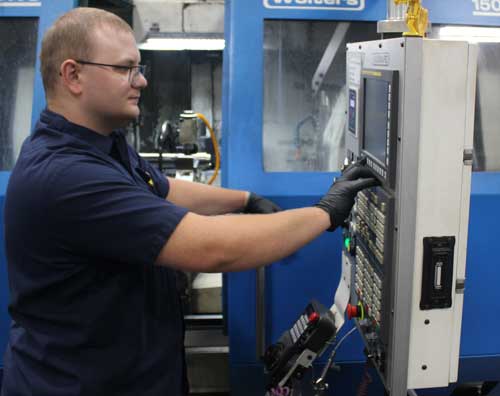 To fix the imbalance problem the spindles first needed to be running at the appropriate running speed. Our technicians did a quick fix for spindle speed by compensating on the PLC, lowering the displayed speed to have actual speed match specs. Using special weights designed for these spindles GTI Predictive technicians fixed the imbalance problem.
Reprogramming the PLC is still required for a true long term solution. Spindle running speeds should always match the displayed running speed. GTI’s temporary fix involved slowing down the displayed number to match the required running speeds to match grinding specs. Running the PLC in this state for a prolonged period of time could cause other issues such as damaging the rotor or stator.
This example demonstrates how important it is to verify the information displayed by the PLC when diagnosing problems. The accuracy of running speeds and other parameters from the PLC can be critical to finding a solution to the problem.
Are you sure that your machines are operating where you think they are? GTI Predictive Technology service specialists can help diagnose and solve your machine problems.
Manchester, NH, 23 September 2015: GTI Spindle Technology, Inc. has acquired Innovative Machine and Design Technology, Inc. to further increase GTI Spindle’s repair and rebuild capabilities; as well as introduce new manufacturing and reverse engineering capabilities.
IMD has an extensive background in components for the automotive manufacturing industry and is known for its quality services including:
Innovative Machine and Design Technology is joining GTI Spindle’s Bloomington, Illinois facility. Grind-Plate-Grind capabilities in Bloomington enables GTI to provide faster turn around time for our customers by doing everything on-site. Integrating IMD into GTI Bloomington allows GTI to expand both our repair service offerings and manufacturing capabilities.
“An important part of our growth strategy is to provide as many services as we can in-house,” said Lisa Bailey-Beavers, VP of Sales. “IMD’s expertise will help us accelerate spindle repair and rebuild capabilities in the midwest. Having their capabilities within GTI allows us to exceed our customer’s expectations”
The acquisition of IMD brings both enhanced rebuilding and new manufacturing capabilities to GTI. Rebuilding of machine tool components includes but not limited to chucks, turrets and gear boxes. Manufacturing of spindle and machine tool components includes but not limited to: shafts, chucks, chuck parts, chuck jaws, machines assembles and parts, pulleys, specialty tools, quills, precision tooling, gages, specialty tool holders and many other components. IMD also brings complete reverse engineering capabilities to GTI.
About GTI Spindle
GTI Spindle Technology (https://gtispindle.com) with locations in Manchester, NH, Bloomington, IL, Romulus, MI and Pontiac, IL offers a variety of services including failure analysis and corrective action programs, vibration analysis diagnostics and guaranteed cost savings programs. They inspect, repair and remanufacture spindles and other precision rotating assemblies including super precision high frequency, motorized, belt and gear driven spindles with emphasis on Japanese and European High Speed Machining Centers.
Discover more about GTI Spindle Technology online at gtispindle.com. Press inquires can be directed to Tim Chaten. Reachable via phone at 603.669.5993 or contacted via email at tim@gtispindle.com.

When asked how they tell if a spindle is failing, many maintenance managers tell us that it is when quality starts rejecting parts, they hear a noise, or the spindle seizes completely.
These tips are meant to help you find and correct spindle problems before catastrophic failure and machine tool crashes. Periodic predictive maintenance and inspection will also help you reduce scrap, decrease downtime and save money on spindle repairs.
“Train everyone lavishly, you can’t overspend on training.”
-Thomas Peters
“Being well trained means you can train others”
-Brette Powell
So, how do we move this training mountain? Here are some things to consider:
If measured on a regular basis, vibration data will give early warning of impending bearing failure. Starting with a baseline measurement and trending over time is the first line of defense to detect problems.
Industry standard alerts and alarms are a simple way of tracking vibration issues. When alerts and alarms occur, more data can be collected on the spindle for more accurate analysis.
Here are some basic tactics for collecting vibration data on spindles:
Add temperature data to your vibration trends for better failure prediction. Temperature increases are an indication of increased friction in the bearing and lubrication issues – both over and under lubrication. Combined with vibration data your monitoring program will give ample early warnings.
Ask you spindle repair provider to include a vibration certification report when a repaired spindle is returned. If your installed vibration readings are significantly different from the shop report, then there could be other components in the system that are contributing to the vibration problems.
At GTI Spindle Technology, we refer to this a “schedule C” repair. $$$$
By removing the spindle when the vibration levels are in the upper end of the velocity thresholds of 0.1-0.2 in/sec and upper end of acceleration thresholds of 2.5-4 g’s you reduce the extent of damage that is caused as the bearings deteriorate. This would typically result in a repair including but not limited to:
This would be classified as a “schedule B” repair. $$$
By removing the spindle when the vibration levels are in the lower end of the velocity thresholds of 0.1-0.2 in/sec and lower end of acceleration thresholds of 2.5-4 g’s you significantly reduce the extent of damage that is caused as the bearings begin to deteriorate. This would typically result in a repair including but not limited to:
This would be classified as a “schedule A” repair. $$
Let’s start by looking look at the basic things you need to keep in mind for proper bearing storage and installation.
 How the bearings are stored and handled is a huge consideration. Rolling element bearings should be stored in a cool, low humidity environment that is free from shock, vibration and dust. Poor storage conditions can cause defects to the bearing races before the bearing is ever used.
Simply, the most effective bearing maintenance is to keep it clean. Spare spindles in storage should be rotated periodically to prevent the bearings resting in the same position. Over time not rotating the spindle can cause flat spots on the bearing that can lead to early bearing failure.
Prior to mounting a new bearing, check the bearing housing and shaft to make sure they are clean and not damaged. Also, check the shaft and housing for out of round and taper. Use the tables supplied by the bearing manufacturer to ensure that the correct amount of clearance will be present when the bearing is installed.
Make sure you are replacing the old bearing with one that is identical. The lubricant must be clean and of the correct specification. Have the correct tools and equipment on hand and keep the work area clean.
Don’t remove the bearing from its wrapping until its time to install and do not wash the bearing. Make sure you know what method will be required to mount the bearing.
Mechanical mounting methods are acceptable for small bearings. Always use the correct mounting tools (as opposed to a sledge hammer) and apply “minimum force with maximum control”. Never strike the bearing directly!
Improper mechanical installation can damage the bearing and start it on the path to premature failure. For larger bearings, heating and induction methods can be used. This method will allow the bearing to fit over the shaft and into the housing more easily.
Once again, the key is training and commitment. Your bearing supplier should have a quality training program. While you can purchase bearings from a number of sources for a variety of prices, availability of training should be a paramount in your bearing supplier selection process.
In an air-oil lubrication system it is critical to bearing life that clean dry compressed air is used. Air from the compressor should be dry and filtered, and filters checked and changed regularly.
An annual compressed air system audit will also prevent contamination, not to mention save additional energy dollars by improving the system efficiency. Additional coalesor filters can be added on the airline ahead of the oiler with 0.5 micron filters for better efficiency.
Seals need to be properly installed to manufacturer specifications to reduce ingress of chips and debris from the machining process. Preventing these chips and debris from building up to the point of contact on seals will also help extend the life of the seal.
All spindle, bearing and seal assembly should be carried out in a clean room to prevent contamination.
When dealing with lubrication, it is always good to go to an expert. Here is a good tutorial from Jarrod Potteiger of Des-Case about proper lubrication handling and storage to prevent contamination. Click here to view the tutorial.
Here is what you will learn:
 Preload is set when the bearing is installed in the spindle. Setting the preload properly is a must for good spindle performance and long bearing life.
Insufficient preload will cause the balls in the bearing to skid or skip, resulting in premature failure and poor tool performance and can lead to poor product quality.
Excessive preload can load can cause heat and friction, leading to premature bearing failure. Bearing preload influence and is influenced by speed limits, rigidity and workloads.
Here are some good rules to remember:
Always pay close attention to the operating specifications provided by the machine tool and spindle manufacturer.
This can lead to premature bearing failure and high spindle repair costs if not addressed in its early stages. More importantly, imbalance in a spindle will diminish product quality and product will be outside its expected tolerances. The first sign of a problem may come from the QA department, resulting in unplanned downtime and scrapped production runs.
Imbalance in a spindle can be caused by many influences:
Imbalance in the vibration spectrum is characterized in the vibration spectrum by a dominant one times peak and, with a little training, is easily recognized. There are industry standard vibration levels to help identify imbalance problems. Imbalance can be corrected in the field with balancing tools and proper training.
Special measuring tools and training are required to detect and correct imbalance. A best practice for helping prevent imbalance is to require all spindles coming into your facility, whether new or rebuilt, to have a certificate of balance included.
Set a standard and make your suppliers live up to it with documentation. Cutting tools and grinding wheels should also be balanced before being installed on a spindle.
Make sure all of your millwrights, mechanics and technicians are trained to recognize and correct imbalance in the equipment they are responsible for.
Check the drawbar force at least every two months using a commercially available mechanical gauge. A good time to check drawbar force is whenever you collect your vibration data. You can record and trend drawbar force as a companion to you vibration and temperature levels.
Specified drawbar force will differ with different machines and spindles:
A drawbar repair can cost hundreds of dollars if caught early. Drawbar failure can cost thousands when you consider the effects of a spindle crash, spindle grinding and lost productivity due to downtime.
Schedule regular visual inspections and use a clear checklist that everyone can understand to document any problems. Make sure everyone understands any gauges associated with the machine (oil level, temperature, pressure, etc.) and that they know the acceptable operating levels.
 Learn what a good running machine sounds like. Then listen for grinding, squeaking and other irregular sounds – all indications of worn or damaged bearings. These noises will be loud compared to a good machine.
Look for problems like oil or grease leaks around seals. Ensure that any debris build-up on the seals is removed. Check for cracked bearing housings and machine feet. Look for missing bolts and check for loose bolts. Check belts for cracks, wear and tension.
Check the lubricant levels for under or over lubrication. Discolored or dark lubricant is a sign that the lubricant is contaminated or worn out. Worn out or contaminated oil may be caused by overheating. If it is cloudy, there may be water contamination. Always make sure the air vent is not obstructed.
If applicable, have a schedule to inspect air filters and ensure that the correct filter is being used.
A good visual inspection program, where every one knows what to look for, should involve all the senses. Feel for excess vibration and hot bearing housings. Listen for sounds that are out of the ordinary. Smell for electrical, friction or burning.
Once a company owns an app, they own it forever. That means that app software is free to the user after the purchase of the first unit. Upgrades are free through the App Store – and they come automatically, with alerts on the iPad when they are available.
Second, all of the different technologies can be developed as apps – vibration, infrared, balancing, ultrasound, motor testing, laser alignment – all can be apps on a single platform. Need a new technology? Contact the vendor for any hardware and download the app. The iPad is a one-time purchase.
Thirdly, iPads are not purpose built. It can function as whatever tool you want it to be that day. Because all of the functionality is developed in software it is simple to upgrade (most upgrades are free through the App Store) and it is simple to add new functions and capabilities as customers ask for them. There is no need for a list of upgrades that will be included in the next version of hardware that you have to purchase to upgrade.
You dropped the iPad? No problem, you run to the local computer store and get a new on; sync all your apps and reload your data from the cloud. It is less expensive and, certainly, takes less time than sending your display unit back for repair and waiting 2-3 weeks to get it back.
What else can we do with an iPad?
One iPad, multiple technologies, add new technologies when you want/need to.
“Learning is not compulsory…neither is survival.”
-W. Edwards Deming
By now you are probably thinking this is all just common sense, but sensible or not, it is not that common. All programs start out with great goals, but without commitment at all levels, great training and good documentation these goals can get lost.
Never be afraid to question the status quo (“Because it has always been that way”) or to ask why. Always look for training opportunities – on-site, classroom or on-line. If you make a strong commitment to the maintenance process – and own it – then others will follow.


GTI Predictive Technology is proud to offer both VibePro and BalancePro updates for free to existing customers.
Stay tuned for more exciting announcements including new iPad applications and a brand new web application for VibePro.
The internet and cloud technology is changing the way companies and individuals accomplish a variety of tasks. Last week GTI shared an article by AmericanMachinist.com discussing the impact the cloud has made on manufacturing performance.
In this post GTI will share some of the cloud technologies we use to be a more productive and streamlined company; as well as how some of our products take advantage of the cloud. The cloud has enabled GTI to collaborate across multiple facilities. By sharing files between the facilities GTI is able to take a look at breakdown photos and other current and past spindle repair files.
The sales team always has up to date information because of the shared Dropbox folder. Files are easily accessible from their phones, tablets or computers and can be retrieved on an as needed basis. Order status and the contact management system can be easily accessed through a Cisco system on any computer, tablet or even their iPhone. The cloud system in place at GTI allows for employees to work from anywhere in the world. The same resources and tools available at all times with a simple internet connection.
Last year GTI started to leverage the cloud in our predictive maintenance products by building out a web application platform. The first application extended VibePro to the web. Full databases can be uploaded and viewed from any computer in the world. Reports can also be generated from this web application. The move to the cloud allows one technician to capture the data and another to analyze that data from anywhere in the world.
VibeCapture is GTI’s second application to get a web application. The app now supports a full database structure like VibePro and that database can be uploaded to a counterpart web application. Full reporting and diagnostic tools are available from the web app.
Additional web applications are planned and some exciting new updates are coming to existing apps. These are just some of the ways that GTI has embraced the cloud. We believe every company can benefit and improve its efficiency through harnessing technology in the proper way. Contact GTI today to learn more about our web applications.
This month GTI Predictive is introducing two new products; both of which will be on display during MARCON 2015 at booth 15. MARCON is held in Knoxville, TN from February 23rd to 26th.
Our recently introduced ultrasonic sensor for iPad will be at the booth along with our new pocket-sized thermography camera.
The ultrasonic sensor can be used to test bearing lubrication and spot air leaks. The range and pin-point accuracy of this sensor make capturing readings a simple process. The app can record, analyze and use slow down playback for sounds normally impossible to hear. The app can also analyze any imported audio file into a spectrogram context. The sensor is plug and play; connected through a single USB cable into the iPad.
The new thermography camera makes capturing thermal images a simpler process. A tiny camera plugs directly into the Lightning connector of the iPad and either video or still photography can be taken right from the iPad. Images captured in the thermography app can be included in VibePro and reports from other GTI apps.
These as well as our existing products will be on display at MARCON. Additional information is available by emailing info@gtipredictive.com or calling 603.669.5993.
GTI Predictive Technology is pleased to announce the immediate availability of PhasePro.
PhasePro is a tool for machine condition monitoring. User can select different type of machine configurations and record the 1X phase and amplitude values for different measuring points. A full accelerometer, phase sensor and DAQ box is needed for vibration readings.
GTI recommends this application for those that need a more powerful diagnostic tool. Stay tuned for a full featured video that shows this application in action!
Features:
Screenshots:


GTI Spindle Technology proudly announces its release of yet another tool for the iPad platform: precision alignment. Now all aspects of predictive maintenance are covered on one platform: vibration analysis, precision balancing, thermography, and now precision alignment. This is the broadest toolset available on a single device.