Author: GTI Staff

  • How IoT and Predictive Maintenance Expedite Spindle Repair

    In manufacturing, there are two ways to approach downtime. The first is to determine what can be done to avoid production halts altogether. The second is to assess how you can manage downtime so that it has the smallest possible impact on operations. Where traditional maintenance strategies were reactive and machine diagnosis was subjective, technological advancements in areas like the Internet of Things (IoT) have greatly reduced the frequency and duration of downtimes, enabling quick repairs and introducing long-term solutions.

    Reactive Solutions: Downtime Every Time

    It’s no industry secret that downtime, whether planned or not, is expensive. Between idle employees and production delays, the costs often accrue far faster than solutions are realized. Research has shown that manufacturing facilities experience an average of 800 hours of downtime annually, or more than 15 hours a week. Where every second counts, it’s easy to imagine how quickly the commas and zeroes begin to multiply.

    Traditionally, a reactive approach has been taken when managing machine maintenance and downtime. Often subjective, technicians rely on a combination of senses (visual and audible) to attempt to diagnose machine failure. While years of experience may assist repair specialists in recognizing spindle faults, the short-term solutions tend to result in long-term problems down the line. Thankfully, technological advances have enabled a more targeted and analytical approach to mitigate downtime and introduce long-term remedies.

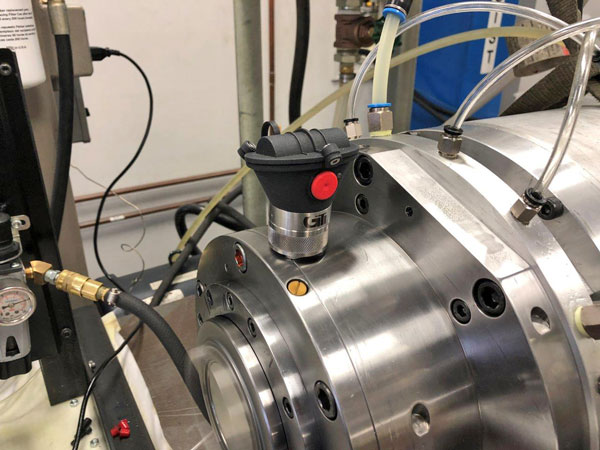
    VibePro Wireless AccelerometerThe Power of IoT Analytics

    Technological advancements in IoT have revolutionized the way manufacturers approach machine maintenance. Now proactive, predictive maintenance programs utilize wireless sensors and remote monitoring to measure machine conditioning. Through powerful data analytics applications, technicians can identify at-risk machines and more accurately diagnose their health. Not only does this reduce the frequency of downtimes, but also allows spindle technicians to more quickly pin-point machine faults and solution paths, reducing the duration of halts as well.

    When harnessing the power of IoT-driven analytics and predictive technologies, subjective guesswork is eliminated, and downtime frequency and duration is reduced. That’s why GTI Spindle Technology technicians apply advanced analytics to our spindle repair services to get your machines not only back up-and-running, but operating at maximum efficiency. Contact us to learn how we can apply our technology-fueled approach to maintenance to your processes.

    About GTI Spindle Technology

    At GTI Spindle Technology, we specialize in high quality spindle diagnosis and repair. Getting your business back into full operation and minimizing downtime is our mission. We offer in-house, on-site, and emergency assistance for machine tool spindle failure analysis, spindle repair, and complete spindle testing. With an extensive range and expertise in a diverse group of industries, our customers know that they are getting the highest quality of spindle repair and customer service. Click here to find out more.

  • What Population Growth & Renewable Energy Mean for Construction Companies

    As the world population continues to grow, so does the demand for new and accommodating infrastructure. Coupled with projected industry growth, construction companies and equipment manufacturers will need to ensure they can handle the influx of projects as younger generations enter the housing market and renewable energy segments become a major focus.

    Population Growth

    While the nation’s current population is over 328 million, that number is estimated to surpass 334 million by 2020. This population growth signifies an increase in demand for corresponding infrastructure. According to one report, residential construction activity is expected to increase from 45% to 54% in 2018, further illustrating the demand for housing. In the same report, 63% of industry executives project an increase in nonresidential construction for the remainder of the year.

    The real driver of increased demand that construction companies must be prepared to accommodate lies in the consumer behavior of Millennials. Over 75 million strong, this generation could transform the housing market as they begin to shift outward from metropolitan areas into more suburban settings. According to one survey, 79% of Millennials currently renting expressed a desire to purchase a home. When the buying potential of these young adults is realized, construction companies and equipment manufacturers can expect a significant demand for residential development.

    Renewable Energy

    As much of the world continues developing environmentally conscious technology and policies, this relatively new industry presents a significant opportunity for construction equipment companies. Referred to as one of the fastest growing construction markets, the renewable energy sector has enjoyed increased spending year after year as governments from around the world combat growing climate issues. For example, in 2016, over 31% of all construction jobs were in energy related projects. With this number projected to grow, an increase in renewable energy ventures will translate into increased demand for construction companies and equipment manufacturers.

    To capture the opportunity presented by the increasing population and focus on renewable energy segments, construction equipment companies and manufacturers must be able to produce in accordance with rising demand. Where downtime can significantly affect your bottom line and production timetables, scheduling routine spindle maintenance is the best way to ensure all machines are operating at peak efficiency to remain competitive as the industry expands. At GTI Spindle Technology, we have the expertise and knowledge to service spindles in construction-related industries. Contact us today to learn how we can help you avoid and minimize downtime so that you can maximize your uptime.

    About GTI Spindle Technology

    At GTI Spindle Technology, we specialize in high quality spindle diagnosis and repair. Getting your business back into full operation and minimizing downtime is our mission. We offer in-house, on-site, and emergency assistance for machine tool spindle failure analysis, spindle repair, and complete spindle testing. With an extensive range and expertise in a diverse group of industries, our customers know that they are getting the highest quality of spindle repair and customer service. Click here to find out more.

  • 3 Common Types of Spindle Failures & How GTI Can Help

    In manufacturing, timing is everything. Each phase of production must work in concert with the one before and after to ensure schedules are kept and impending deadlines are met. While technological advancements continue to enhance production capabilities by streamlining processes, machine failures and production halts remain prevalent, jeopardizing manufacturing timetables and directly affecting the bottom line.

    There’s no denying that unplanned downtime happens. According to a study by Aberdeen Research, nearly 82% of companies have experienced unexpected downtime in the last few years with some costs totaling $260,000 an hour. While there are some strategies in place to predict and prevent potential failures, how quickly you act to resolve the machine issue at hand could save you a significant amount of money and frustration.

    If one of your machines has failed or you suspect it might fail soon due to spindle failure, the knowledgeable professionals at GTI Spindle Technology are trained to service spindles in a variety of industries so you can get production back up to speed as soon as possible.

    Below are three of the most common types of spindle failures and what causes them.

    1. Spindle Bearing Failure

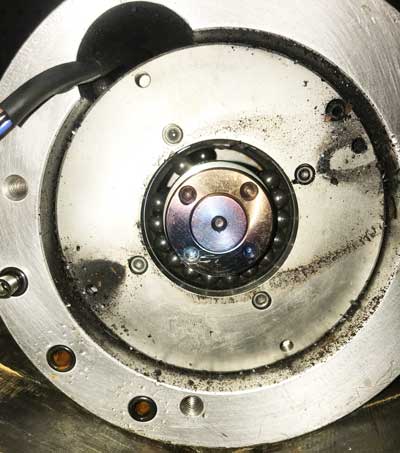
    Spindle Failure Bearing ContaminationFrequently a result of bearing contamination, bearing failure can lead to full spindle failure if not properly maintained and repaired. When the machine/spindle is shut down, allow the air supply to continue to run until the spindle cools. If the air is shutdown when the machine/spindle is down, the cooling of the spindle will suck any coolant and/or chips into the spindle like solder into a joint. Be sure to also wipe down the shaft face and front area of any coolant and/or chips. In addition, minimize the use of high pressure air guns to “blow off” chips and/or coolant and do not direct this air at the spindle as air guns surpass the positive pressure and will force contaminants into the spindle.

     2. Spindle Taper Repair

    Often a case of simple wear and tear, a damaged taper can cause complex machine issues. Typical signs of decline can be seen in straight marks on the taper indicating fretting. Because the taper is subjected to high speed conditions and regular tool changes, natural deterioration can lead to a multitude of larger issues affecting machining and should be resolved as soon as possible.

     3. Drawbar Repair

    Like most spindle faults, wear and tear is most commonly responsible for drawbar failures, alongside spring failures. Often indicated by tool chatter and eventual fretting, drawbar failures can also be linked to problems with actuators, dogs, gripper arms, and a host of other components, making it important to complete drawbar maintenance and/or repairs swiftly.

    If you’re experiencing a production halt or suspect a spindle failure may occur, contact the knowledge professionals at GTI Spindle Technology to minimize your downtime and maximize your uptime. Because every second counts, count on GTI.

    About GTI Spindle Technology

    At GTI Spindle Technology, we specialize in high quality spindle diagnosis and repair. Getting your business back into full operation and minimizing downtime is our mission. We offer in-house, on-site, and emergency assistance for machine tool spindle failure analysis, spindle repair, and complete spindle testing. With an extensive range and expertise in a diverse group of industries, our customers know that they are getting the highest quality of spindle repair and customer service. Click here to find out more.

  • Automotive Industry Trends in 2018

    A lot has changed in the century since Henry Ford introduced his revolutionary quadricycle and launched Ford Motor Company. While the once-novel Model T was produced on crude assembly lines, modern technological advancements have enabled mass production of today’s most futuristic vehicles. A true representation of shifting consumer preferences and production capabilities, the automotive industry is projected to continue transforming to normalize features that were once deemed science fiction. To maintain operational efficiency as consumer trends continue to change, it will be important for manufacturers to conduct routine spindle maintenance and repairs to avoid production halts.

    Industry Performance

    As a result of IIoT, auto manufacturers have been able to make major strides in extending the capabilities of today’s vehicles. The same can be said about the machines used to produce them. With these new features come new vehicle classes and services, driving the automotive industry into a new, technology-fueled era. Experts estimate that the industry’s worth will be $6.7 trillion by 2030, a drastic increase when compared to 2015’s $3.5 trillion valuation. With over $1.5 trillion of the industry’s growth being attributed to emerging tech and services, it’s important to understand some of the 2018 automotive production trends made possible by these advancements.

    Electric

    With greater importance being placed on climate change, the automotive industry continues to ramp up the production of environmentally conscious vehicles. In congruence with changing environmental regulations, electric and hybrid vehicles have experienced significant increases in adoption rates. It’s estimated that there will be over 41 million electric vehicle sales by 2040 encompassing 25% of the total market.

    Connected

    In today’s global marketplace, smart technology reigns supreme. Given recent advancements in IoT and seamless connectivity, consumers expect their vehicle to share the same smart capabilities as their phones, tablets, and other appliances. Today’s smart vehicles offer a range of digital services to amplify the user’s after sales experience. Predictive settings and AI can notify drivers of potential part failures and recognize personal settings and preferences. To better illustrate the growing demand of connected vehicles, let this statistic paint a vivid picture: by 2020, experts project that 98% of the cars on the road will be connected vehicles.

    Autonomous

    Auto manufacturers are racing to develop and market fully autonomous vehicles. While only a handful of companies like Tesla currently offer vehicles with self-driving capabilities, the advantages of a truly “driverless” car have captivated the masses by selling a glimpse into the future. According to experts, autonomous vehicles can not only save drivers a significant amount of commuting time by identifying faster routes (250 million hours), but they can also potentially save hundreds of thousands of lives by greatly reducing the human error associated with driving. By 2030, it’s estimated that over 70% of the cars sold will have self-driving features and that 15% will be fully autonomous — highlighting how close we are to the commercialization of this technology.

    As the automotive industry continues to adapt to shifting consumer vehicle preferences, it’s imperative that manufacturers ensure they maintain production capacity to meet increased demands for trending technology. Where downtime in the automotive industry has been quoted at costing $20,000 a minute, routine spindle maintenance and repairs can help manufacturers avoid costly production halts and maximize their production output as auto manufacturing becomes more futuristic.

    Contact the professionals at GTI Spindle Technology to learn about our spindle services for the automotive industry and ensure you’re producing at peak efficiency to be ready for the future.

    About GTI Spindle Technology

    At GTI Spindle Technology, we specialize in high quality spindle diagnosis and repair. Getting your business back into full operation and minimizing downtime is our mission. We offer in-house, on-site, and emergency assistance for machine tool spindle failure analysis, spindle repair, and complete spindle testing. With an extensive range and expertise in a diverse group of industries, our customers know that they are getting the highest quality of spindle repair and customer service. Click here to find out more

  • Spindle Repair in The Aerospace Industry

    If one were to compare the aerospace industry of today to what it was in the early 1900’s, they would note that, aside from planes still having wings, the two are unrecognizable. Like most industries, the aerospace and defense sectors have experienced multiple revolutions as a result of technological advancements. Despite the introduction of transformative technologies and relative progress, aerospace manufacturers are racing to keep pace with increasing consumer demand.

    Industry Outlook 2018

    At a glance, the aerospace industry’s outlook is positive for 2018. Aircraft deliveries are projected to increase by 9% and production output is continuing to grow year after year. When also considering the industry’s current low interest rates, moderate fuel prices, significant international demand, and growth in airline traffic, it is expected that the industry will remain strong throughout the remainder of the year.

    Production Concerns

    Despite making technological strides and increasing production by 40% since 2011, aerospace companies are continually adding to their already substantial backlogs. For example, although Boeing delivered 763 aircrafts in 2017, their current backlog totals 5,864 planes, or in other words, seven years of production. Experts have attributed this buildup to the complexity of the industry’s supply chain and inefficiency of current production machines.

    Smart Manufacturing

    To combat production shortcomings, aerospace companies are beginning to introduce smart manufacturing to their processes to improve efficiency and reduce backlogs. In fact, 62% of all aerospace manufacturers reported having some type of smart manufacturing initiative in place in March of 2017; a greater adoption percentage than any other industry. As a result of IoT and AI, the utilization of smart sensors and simulation programs have proven to strengthen supply chain communication and optimize part performance. While these technological improvements have had a positive impact on aerospace manufacturing by increasing deliveries, backlog totals continue to climb.

    In an industry susceptible to backlog buildup and delayed deliveries, it is imperative that aerospace manufacturers operate at peak efficiency by ensuring that machines undergo routine spindle maintenance and repairs. Avoid costly downtime and maximize your production by contacting the industry professionals at GTI Spindle Technology and learn how your aerospace manufacturing operations can benefit from our spindle services.

    About GTI Spindle Technology

    At GTI Spindle Technology, we specialize in high quality spindle diagnosis and repair. Getting your business back into full operation and minimizing downtime is our mission. We offer in-house, on-site, and emergency assistance for machine tool spindle failure analysis, spindle repair, and complete spindle testing. With an extensive range and expertise in a diverse group of industries, our customers know that they are getting the highest quality of spindle repair and customer service. Click here to find out more.

  • New Demand & New Technology: Spindle Repair in the Agriculture Industry

    Throughout time, agriculture has remained a staple in economies all over the world. Like any industry, the agricultural sector has been no stranger to industrialization and developing revolutionary technologies to streamline operations and scale to accommodate growing population demand. What once took days of human labor, now only takes hours with the help of new technology and machinery.

    However, this increased efficiency brings unique challenges. More machines means more opportunities for machine and spindle failure, which subsequently result in costly downtime. It is important for those in the agricultural industry to employ regular spindle maintenance and repair schedules while introducing groundbreaking technology to their processes.

    New Demand

    Agricultural demand shares a direct relationship with the global population. After growing by over 76 million in 2017, the world’s population is currently 7.6 billion and continuing to grow with staggering speed. With more mouths to feed and the agricultural industry responsible for supplying all the necessary crops, it’s no surprise that the industry has transformed and introduced new technology to streamline processes and improve efficiency.

    New Technology

    Advancements in robotics and automated machines have revolutionized the agricultural sector. In many cases, the technological developments have introduced new devices and reduced the number of labor hours required by farmers. An example of this new tech can be seen in the growing popularity of lighter, automated tractors, and machines that improve performance, precision, and efficiency.

    Increased demand, and reliance on new machines and technology, means the financial impact of machine failure and downtime also increases. In a time-sensitive industry like agriculture, operational halts leave fields unharvested and unfertilized, directly impacting the bottom line.

    Much of this downtime can be reduced, if not prevented, by employing proper spindle maintenance and repair. Contact the knowledgeable professionals at GTI Spindle Technology to learn how agricultural spindle repair and maintenance services can benefit your operations.

    About GTI Spindle Technology

    At GTI Spindle Technology, we specialize in high quality spindle diagnosis and repair. Getting your business back into full operation and minimizing downtime is our mission. We offer in-house, on-site, and emergency assistance for machine tool spindle failure analysis, spindle repair, and complete spindle testing. With an extensive range and expertise in a diverse group of industries, our customers know that they are getting the highest quality of spindle repair and customer service. Click here to find out more.


  • Tips on Correcting an Unbalanced Spindle

    Correcting Unbalanced CNC Spindle
    One of the leading causes of machine tool failure is imbalance. A spindle can become unbalanced due to a variety of causes, which can result in damage to other components. Spindle imbalance occurs when a spindle’s center of mass is not aligned with its center of rotation, causing the energy to transfer to the tool and work piece. A few causes of imbalance include thermal fluctuation, improper/inattentive maintenance, poor tools, bent or bowed shafts, and occasionally, product build-up.

    To fix a spindle that has become unbalanced, the axis of inertia must be restored to nearly-perfect alignment with the axis of rotation. While the effects of imbalance are slightly less noticeable on low-speed machine tools, it is critical that high-speed spindles be balanced to ensure optimal performance and a maximum lifespan.

    To fix spindle imbalance, a balancing system is required, specifically one that has a two-plane function. For these tips on correcting spindle imbalance, we will be describing a common balancing system setup that features a tachometer, an accelerometer, and two-plane balancing software with a digital data readout display (i.e. an iPad tablet).

    Once you have a setup like this in place, the following tips will help you conduct the balancing process and minimize potential errors:

    • Weight Recommendation – Spindles come in a wide range of weight-ratings, some weigh less than 20lbs while others can weigh more than 100lbs. The software will recommend the exact recommended trial and correction weight, based on the estimated rotor/shaft weight.
    • Rotation Direction – Ensure that your spindle and software are set for the same rotation direction. If your device is set up for clockwise rotation, it is important that your software is set up to gather data according to clockwise rotation. This is a common error made when balancing machine tools.
    • Tachometer Signal – Verify that your tachometer is exhibiting a signal. It is common for tachometers to lose their signal due to being bumped or moved. It is also common for the reflective tape to fall off during the process of balancing, so be sure to monitor tape placement.
    • Tachometer and Accelerometer Alignment – The setup of your tachometer and accelerometer is key to the proper balancing of a spindle. Ensure that your tachometer is facing the accelerometers, on the same side, and on the same horizontal or vertical plane.
    • Misalignment and Tool Looseness – A spindle that is misaligned or loose is virtually impossible to balance. It is critical that you check for these two factors before attempting to balance a spindle.

    The benefits of regularly balancing a spindle include enhanced machine accuracy and efficiency, longer tool life, and increased life of related components such as bearings. Balancing will also decrease the noise and vibration levels created by machine tools during operation.

    These are general guidelines for balancing a spindle. For specific spindle balancing needs, contact an experienced professional with the correct equipment and expertise.

    About GTI Spindle Technology

    At GTI Spindle Technology, we specialize in high quality spindle diagnosis and repair. Getting your business back into full operation and minimizing downtime is our mission. We offer in-house, on-site, and emergency assistance for machine tool spindle failure analysis, spindle repair, and complete spindle testing. With an extensive range and expertise in a diverse group of industries, our customers know that they are getting the highest quality of spindle repair and customer service. Click here to find out more.
  • 3 Non-Invasive Methods for Diagnosing Spindle Errors and Problems

    If you operate a manufacturing plant or similar business, keeping your production line running at maximum efficiency is crucial. Over time, the spindles within your rotating machinery can experience errors that can decrease performance, or in the worst-case scenario, cause complete machine failure. Monitoring the “health” of your spindles is an important part of minimizing downtime.

    Here are three non-invasive methods for determining if your spindles are operating at maximum efficiency: 

    Measure Total Indicated Runout

    Measuring your spindle’s total indicated runout is one method of ensuring maximum tool life. Runout can occur when a tool is rotating off its axis, either at an angle from one end of the shaft to the other, or as a whole. This causes it to rotate unevenly and negatively impact tool life. A few reasons that runout can occur include contamination within the tool, improper or subpar tool holders, and/or skewed machinery.

    For this measurement, you will need a dial test indicator. After securing the dial test indicator in place with its needle on the shaft, you can rotate the shaft and observe the indicated runout. By placing the dial test indicator on different rotating sections of the tool, you can determine whether your spindle is operating within runout tolerances. To ensure that your spindle is performing at maximum efficiency, you should be aiming for 2 microns or less of runout when performing this test. Anything more than this amount can mean a loss of accuracy, a loss of power, and higher vibration levels.

    Check Tool Retention Force

    When a drawbar spring within a spindle is not preloaded properly, it can cause a variety of issues and damage other spindle components or complete equipment failure. Drawbar springs are dependent on each other for the tool to function properly, so if one spring fails, the other springs can become overburdened. A spring issue can go unnoticed, but once one fails, the others may follow. Testing the tooling retention of these springs enables you to determine, without disassembly, if your spindle is experiencing a drawbar issue before the issue can affect other components.

    In order to measure tool retention, you will need a drawbar force gauge. By inserting a drawbar force gauge into your spindle, you can measure the stress of your springs. The tooling retention force can differ depending on your specific spindle. Most drawbar springs operate with a retention force between 2,000 and 7,000 psi. Be sure to refer to the manufacturer specifications when determining the proper range for a particular spindle.

    Vibration Analysis

    When a spindle is experiencing an error, it will typically create a vibration signature that is indicative of a specific problem or problems. Vibration analysis can determine which area of the spindle is experiencing damage and/or decreased performance. Vibration analysis can detect prevalent spindle problems such as misalignment, balancing issues, bearing issues, and low drawbar force. In this case study, vibration analysis was able to accurately detect multiple spindle errors including rotor imbalance and a bearing issue.

    The most accurate way to identify vibration signatures is by affixing a vibration-sensitive device, such as GTI’s VibePro to your spindle. Gathering data and monitoring spikes in vibration levels can help you determine if your spindle is operating within its parameters for peak efficiency. If there is a vibration signature that suggests something is wrong, the signature can be analyzed to determine where the problem is occurring within the spindle.

    VibePro Wireless AccelerometerIf you have conducted these tests and did observe issues, it may be necessary to move from non-invasive diagnosis to disassembly and repair. Any invasive work that involves removing a spindle from a machine should be conducted by a trained professional. Remember, keeping your equipment in the best possible condition is critical to minimizing downtime, and minimizing downtime is critical to success.

    About GTI Spindle

    At GTI Spindle, we specialize in high quality spindle diagnosis and repair. Getting your business back into full operation and minimizing downtime is our mission. We offer in-house, on-site, and emergency assistance for machine tool spindle failure analysis, spindle repair, and complete spindle testing. With an extensive range and expertise in a diverse group of industries, our customers know that they are getting the highest quality of spindle repair and customer service. Click here to find out more.

  • 3 Common Reasons for Spindle Bearing Failure

    Like all moving machine elements, bearings in spindles can fail due to a variety of causes. While normal wear and tear is one of these causes, there are specific points of failure that are more common than others. Before it becomes necessary to repair a spindle due to bearing damage, consider these factors that may lead to spindle bearing failure:

    Improper Lubrication:

    Spindle Failure Improper Lubrication
    Evidence of Improper Lubrication

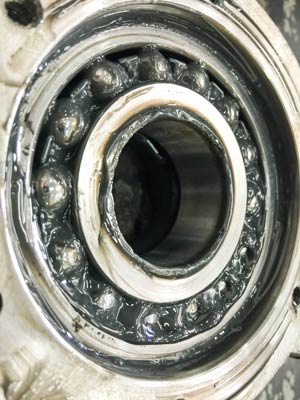
    Lubricant is critical when it comes to spindle performance; it affects maximum operating speed, temperature and vibration levels. Improper lubrication can cause bearing failure in several different ways. The most prevalent lubrication error is using an insufficient amount. This can lead to increased wear due to friction as well as thermal damage due to higher operating temperatures. The resulting damage to bearings can include rolling element deterioration, raceway deterioration, cage fragmentation, and eventually spindle failure.

    When it comes to lubrication, here are three things to keep in mind to ensure longer bearing life:

    Always use the right type of lubricant: There are many types of bearing lubricant – be sure that you are using the right compatibility and viscosity. Quality is also a significant factor, and a sub-par lubricant can increase the chance of wear in a bearing.

    Always use the right amount: An insufficient amount of lubrication can cause damage to your bearings, but too much lubrication can also cause issues. Following lubricant specifications for your machinery will increase the life-span of your bearings.

    Always apply lubrication at the right time: Applying lubricant too often or not often enough can lead to bearing failure, even if you are using the right type and amount. Adhering to a lubrication schedule will ensure maximum performance.

    Contamination:

    Spindle Failure Bearing Contamination
    This spindle failed due to contamination

    The next common source of bearing failure in spindles is contamination. Contamination can be introduced to bearings through various fluids and particulates, dramatically shortening their life span. Two typical sources of contamination include:

    Coolant contamination: Using an air hose to blow coolant and away from your equipment can force various particles into the spindle, contaminating the bearings. Misdirected coolant nozzles can also introduce particles into the bearing. Positive pressure purging seals can be a good line of defense against this form of contamination.

    Chip and Air Contamination: Air can be one of the most expensive commodities in a manufacturing plant. In an effort to reduce these costs, machines are often programmed to stop air supply when the spindles are not in process.  This is actually a costly mistake. Spindles can operate at very high temperatures, and premature removal of an air hose from a hot spindle can create a vacuum in which contaminates are drawn into the spindle, like solder into a joint.

    Chip contamination can also occur when an air hose is disconnected from the spindle and laid into a dirty environment.  Turning the air on and letting it run for approximately five seconds before connecting the hose to your spindle is a good method for eliminating contaminants in the air supply.

    Mishandling:

    While spindles and their bearings may seem like sturdy pieces of equipment, they are actually sensitive to mishandling. Even the smallest impact can set a spindle up for bearing failure. Things to keep in mind when handling a spindle:

    Proper storage: Storage of machinery and parts can be different depending on your equipment. When storing spindles, there are a few notable factors that can affect their performance. Maintaining a low-humidity storage area ensures that condensation does not accumulate. Drastic changes in temperature can also affect spindles and bearings. A dry area that does not fluctuate outside of 65°-120° Fahrenheit is ideal for storage.

    In addition to stable temperatures, stable levels of vibration are also important when it comes to storing spindles. Spindles should be stored in areas with very low vibration to ensure maximum performance when they are put into use. All coolant and oil ports in a spindle should be plugged to avoid contamination. Wrapping spindles with oil paper also ensures spindle health during storage.

    Spindles that have been sitting stationary on a shelf for an extended period of time are also subject to a phenomenon known as micro-welding. After approximately 3-6 months, the balls within the bearing can “weld” themselves to the raceway, which can lead to spindle failure. This can be avoided by hand rotating your spindle periodically by 1-2 revolutions.

    Proper handling/installation: Utmost caution should be used when moving a spindle before installation. Even small impacts, burrs, or nicks can reduce performance and lifespan. When it comes time to install a spindle, it is crucial to use the proper tools in a clean work environment. Any form of shock load to the spindle can lead to brinelling, a condition in which the bearing raceways become impacted. It is recommended that installation, storage, and handling all be handled by professionals.

    A spindle is the heart of your machine, and bearings could be considered the heart of the spindle. Keeping your spindles in optimal operating condition is crucial in minimizing downtime. By practicing proper methods for lubrication, avoiding contamination, and improving handling, you can ensure that your spindle will operate at maximum efficiency.

    About GTI Spindle Technology

    At GTI Spindle Technology, we specialize in high quality spindle diagnosis and repair. Getting your business back into full operation and minimizing downtime is our mission. We offer in-house, on-site, and emergency assistance for machine tool spindle failure analysis, spindle repair, and complete spindle testing. With an extensive range and expertise in a diverse group of industries, our customers know that they are getting the highest quality of spindle repair and customer service. Click here to find out more.

  • VibePro-EX Now Available – Explosion Proof Vibration Analysis System

    03 May 2016 – GTI Predictive Technology, Inc., creators of the VibePro iPad Data Collector, have released VibePro-EX, a groundbreaking explosion proof vibration analysis package for iPad. The package includes a wireless Bluetooth accelerometer, a specially certified explosion proof iPad case meeting all hazardous compliance standards, and a new version of GTI’s vibration analysis software, VibePro.

    Developed specifically for the iPad, the new sensor connects seamlessly over Bluetooth 4.0, is Class 1/Div 2 approved and has a field replaceable battery that lasts up to 5 years. A computer processor is also built into the accelerometer allowing GTI’s software to perform more advanced functions not available with other sensors.

    The VibePro EX app builds on the great foundation of VibePro. The sensor is a smart sensor with its own CPU allowing VibePro EX to change the sensitivity of the sensor as needed. Users can change the capture sensitivity to any of the following (in mV/g) 50, 100, 250, 500, 1000, 2500, or 5000.

    Featured in this version of VibePro is a single capture to simultaneously gather time waveform data, acceleration and velocity spectrums (with displacement available on the web application). The iPad app includes additional post-processing tools like demodulation, windowing and filters.

    The VibePro EX package is now available. Pricing and additional information about VibePro EX can be obtained by contacting GTI Predictive Technology at info@gtipredictive.com or calling us at (888) 473-9675. VibePro-EX is also available in a non explosion proof version.

    b2ap3_thumbnail_VibePro-EX-System.png

    About GTI Predictive Technology

    Changing Predictive Technology: Founded in 1997, GTI Predictive Technology brings their experience in asset monitoring and repair to the predictive maintenance industry. Our passion for helping others through predictive maintenance allows us to continue to improve our products based on real customer demand.